
Timber Mats vs. Composite Mats: How to Choose the Right Ground Protection
Every crane pick, pipeline pull, and heavy equipment delivery begins with the same fundamental question: will the ground hold? For contractors working across soft soil, saturated terrain, or environmentally sensitive ground, the answer determines whether a project stays on schedule or stalls out entirely.
OSHA leaves relatively little room for interpretation on this point. Under 29 CFR 1926.1402, equipment cannot be assembled or operated unless ground conditions are “firm, drained, and graded” sufficiently to satisfy the manufacturer’s requirements for adequate support. The same regulation identifies the accepted solution, defining supporting materials as blocking, mats, and cribbing.
That means you need matting, and the practical question becomes which type. Most contractors are weighing hardwood timber mats against HDPE composite mats, and the two products are not interchangeable despite frequently being discussed as though they were. In this post, Viking Mat walks you through how they differ structurally, what the published specifications actually indicate, and how to determine which option fits the demands of your job site.
What’s the Difference Between Timber and Composite Mats?
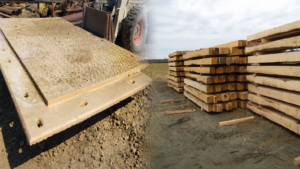
Timber mats — also referred to as crane mats, access mats, or swamp mats — are constructed from solid dimensional timbers, typically 8 or 12 inches thick, secured together with steel through-bolts. White oak and mixed hardwood are the most common species, while Douglas fir and southern yellow pine appear in applications where reducing weight matters more than maximizing crush strength. Viking Mat supplies 8″ timber and 12″ timber mats. We also carry 3-ply laminated and CLT options, which are built from bonded layers rather than bolted timbers. That construction delivers a flatter, more stable panel.
Composite mats are molded from high-density polyethylene, commonly abbreviated as HDPE. They are hollow-cored and completely non-absorbent. Panels connect edge to edge using overlapping joints and a stainless steel pin system, producing one continuous running surface rather than a series of independent panels.
The essential distinction is straightforward. Timber concentrates its strength into thickness and mass. Composite spreads a thinner panel across a wider footprint and relies on the interlocking connection to share loads.
1. Size, Weight, and Load-Bearing Capacity
Here is how the two materials compare across the specifications that matter most during selection.
| Specification | Hardwood timber mats | HDPE composite mats |
|---|---|---|
| Thickness | 8″ or 12″ solid timber | Approximately 4.25″ |
| Common panel size | 4′ wide × 16′–40′ long | 8′ × 14′ |
| Weight per panel | 8″ averages roughly 155 lb per foot (a 4′×16′ is approximately 2,500 lb); 12″ averages roughly 240 lb per foot (a 4′×16′ is approximately 4,300 lb) | Approximately 1,050 lb |
| Load capacity | Up to 200,000 lb, depending on subsurface conditions and configuration | Rated to distribute up to 650 psi |
| Water absorption | Absorbs moisture, though waxed ends slow penetration considerably | Non-absorbent |
| Rot, chemical, and UV resistance | Requires ongoing maintenance | Resistant |
| Field repairability | Individual timbers can be replaced or reinforced | Panel replacement |
It’s worth emphasizing that load capacity is not an inherent property of the mat itself. Capacity depends on the mat, the ground beneath it, and how the mats are configured on site. Always confirm ratings for your specific product and application.
2. Which Material Handles Heavier Loads?
Timber, decisively, though understanding the reason behind that advantage matters more than the conclusion itself.
When a crawler crane track or an outrigger float delivers a concentrated point load, the mat must bridge any soft spots beneath it without deflecting into them. Thickness is what provides that resistance, and a 12-inch timber mat offers nearly three times the depth of a composite panel, which is where published capacities approaching 200,000 pounds originate.
Composite mats are engineered to address a fundamentally different challenge. They distribute moderate loads across a wide, continuous surface, deriving their strength from the interlocked system as a whole rather than from any single panel bridging a void. This makes them well suited to haul roads, laydown yards, and general crew access, but poorly suited to serving as cribbing beneath crane outriggers.
This distinction accounts for the most common and most expensive mistake in ground protection: treating a mat rated for distributed traffic as though it were rated for concentrated lifting loads. Under 1926.1402, the responsibility falls to you to verify that supporting materials meet the crane manufacturer’s specification, and a composite access road does not satisfy that requirement for the pick itself.
3. Which Performs Better on Environmentally Sensitive Sites?
Both materials protect the ground surface by reducing bearing pressure and eliminating rutting. The meaningful differentiator between them is contamination risk.
Because composite is entirely non-absorbent, it will not transport soil, seed, or contaminants between locations. For projects operating across multiple sites under invasive species management plans or remediation protocols, that closed surface represents a genuine compliance advantage, and it washes down cleanly between deployments.
Timber’s environmental case is different and frequently stronger where it counts. Hardwood is renewable, with no end-of-life plastic disposal question. Laminated mats are also regularly specified as an alternative to topsoil stripping, letting contractors build temporary access without disturbing the soil profile. In saturated ground, wetlands, and swamp crossings, timber’s mass and thickness allow it to carry loads over muck where a thinner panel would simply submerge.
If your permit language centers on cross-contamination, composite deserves serious consideration. If it addresses wetland crossings, soil disturbance, or material sustainability, timber is generally the stronger choice.
4. Handling and Transportation Logistics
Weight drives cost in this category, and the difference between the two materials is substantial.
A 12-inch timber mat weighing roughly 4,300 pounds translates to fewer mats per truckload and requires an excavator or loader on site for placement. A composite panel weighs approximately 1,050 pounds while covering 112 square feet, delivering more coverage per pound, more panels per load, and lighter equipment requirements for installation.
For short-duration work in remote locations where every truck movement represents a meaningful line item, composite’s transport efficiency can outweigh timber’s lower unit cost. On extended projects with a crane already mobilized to the site, that handling advantage largely disappears and timber’s superior capacity becomes the deciding factor.
Rail access shifts the calculation again. Timber moves economically by rail in volume, which becomes significant on transmission and pipeline projects staging hundreds of mats across an extended corridor.
If you are working out delivery counts, our guide to how many mats you need breaks down coverage, weight, and truckloads by mat size.
5. Which Option Lasts Longer?
Composite holds the advantage in raw resistance, while timber holds the advantage in repairability.
HDPE does not rot or absorb moisture, and it withstands chemical exposure and UV degradation, meaning a composite mat deteriorates slowly and predictably over its service life. Timber’s primary vulnerability is standing moisture, and its longevity depends substantially on care: waxing the ends to resist penetration, storing mats off bare ground, and cleaning them between deployments. Properly maintained hardwood mats are routinely recovered and reused across many years and multiple projects.
The offsetting consideration is that timber remains field-serviceable. A cracked timber can be replaced and a loosened through-bolt retorqued, restoring the mat to full service, whereas a compromised composite panel generally requires outright replacement.
Timber additionally creates a purchasing option that composite has no equivalent to. Graded used mats deliver most of the structural performance at a lower cost. That makes them well suited to access roads and laydown areas where appearance doesn’t matter, which preserves your new inventory for critical crane pads.
6. When to Choose Each Option
Hardwood timber mats are the right choice when:
- Cranes, piling rigs, or track machines will impose concentrated point loads
- The project involves crossing wetlands, swamp, or saturated soils
- Work is long-duration with heavy equipment already mobilized
- Permit conditions restrict topsoil stripping or soil disturbance
- You require outrigger cribbing or a rated crane pad
Composite mats are the right choice when:
- Traffic consists of trucks, pickups, and light-to-medium equipment
- Mats will relocate between sites with contamination controls in effect
- Transportation costs are the dominant budget consideration
- You need a rapidly deployed, continuous running surface
- Mats face prolonged chemical or UV exposure
Many projects call for both. On larger jobs, contractors frequently establish composite haul roads and laydown areas for general access, then set timber crane mats at each lift location. The two materials are solving genuinely different engineering problems, and specifying a single option for both applications inevitably compromises whichever use it fits less effectively.
Frequently Asked Questions
Can composite mats be used as crane pads? Generally not as a substitute for rated crane mats or cribbing beneath outriggers. Composite mats are engineered to distribute traffic loads across an interlocked surface rather than to bridge soft spots under concentrated outrigger loading. Because OSHA 1926.1402 requires supporting materials to meet the crane manufacturer’s specification, verify the rating against that specification before proceeding with the pick.
How thick should a timber crane mat be? Eight-inch mats are typical for access roads and lighter equipment, while 12-inch mats are standard wherever cranes, piling rigs, and heavy track machines are involved. That said, thickness should ultimately derive from a ground bearing pressure calculation for your specific equipment and subsurface conditions rather than from a general rule of thumb.
How much does a timber mat weigh? Approximately 155 pounds per linear foot for an 8-inch hardwood mat and approximately 240 pounds per linear foot for a 12-inch mat. A 12″ × 4′ × 16′ hardwood mat weighs in the neighborhood of 4,300 pounds.
Are used timber mats worth purchasing? For appropriate applications, absolutely. Graded used mats deliver most of the structural performance at a lower acquisition cost, which makes them a sound choice for access roads, laydown yards, and staging areas. Request the grading criteria before purchasing so you understand how much service life remains.
Should I rent or buy ground protection mats? Project duration is the deciding factor. Short-term jobs and one-off projects generally favor rental or lease. Multi-year programs and recurring work favor purchase, particularly where a buy-back program lets you recover value at project close.
Final Thoughts: Match the Mat to the Application
There is no universally superior mat, only the appropriate mat for what you’re placing on it and what you’re placing it over. Calculate your loads accurately, account for ground conditions and permit requirements, and the correct specification generally becomes evident.
Viking Mat has supplied the construction industry since 1910. We operate more than 80 storage facilities across the United States, with in-house rail and over-the-road logistics and rental, lease, and buy-back options on new and used inventory. Because we carry hardwood timber, laminated, CLT, graded used, and composite matting, our recommendation follows your load calculation rather than our inventory.
Contact us today to discuss your equipment weights, subsurface conditions, and site access requirements, and we’ll help you get the right mats where you need them.
Specifications reflect standard industry ranges and have been reviewed by Viking Mat’s mat traders. Load ratings vary by product, ground conditions, and application. Confirm ratings for your specific site with your supplier and a qualified engineer.